Interpreting Time Through Architecture and Landscape
Interpretation and experience centers constitute a distinct and increasingly
significant architectural typology, conceived as civic interfaces where
architecture, landscape, interpretation, and movement converge to support
tourism, education, and regional development. They play a pivotal role in
revealing the deeper narratives of a region, translating sites of scientific
and ecological significance into legible, accessible public landscapes.
Site Area : 6 Acres Builtup Area : 23,680 SF Services :Master Planning, Urban
Design, Architecture, Landscape Design,
Detailed Project Report (DPR),
Infrastructure Engineering, TechnoCommercial Assistance, Execution
Supervision
Share ►
A Landscape of Deep Time and Global
Significance shaped by Time and Rain
Over its 4.57 billion year history, the Earth has continually evolved, leaving behind a layered record of geological and geomorphic processes. Certain landscapes hold this record with greater clarity than others, offering rare and valuable insights into the natural forces that have shaped the planet over deep time.
Situated in Sohra, one of the wettest regions on Earth, Mawmluh Cave holds global importance as the stratotype site defining the Meghalayan Age, the most recent division of Earth’s geological timeline. Despite being the only IUGS geological site in India, it remains under-represented within the region’s tourism and knowledge infrastructure. The Experience Center seeks to translate this extraordinary geological legacy into a legible and immersive visitor experience, integrating geology, climate history, and indigenous cultural narratives into a coherent public experience.
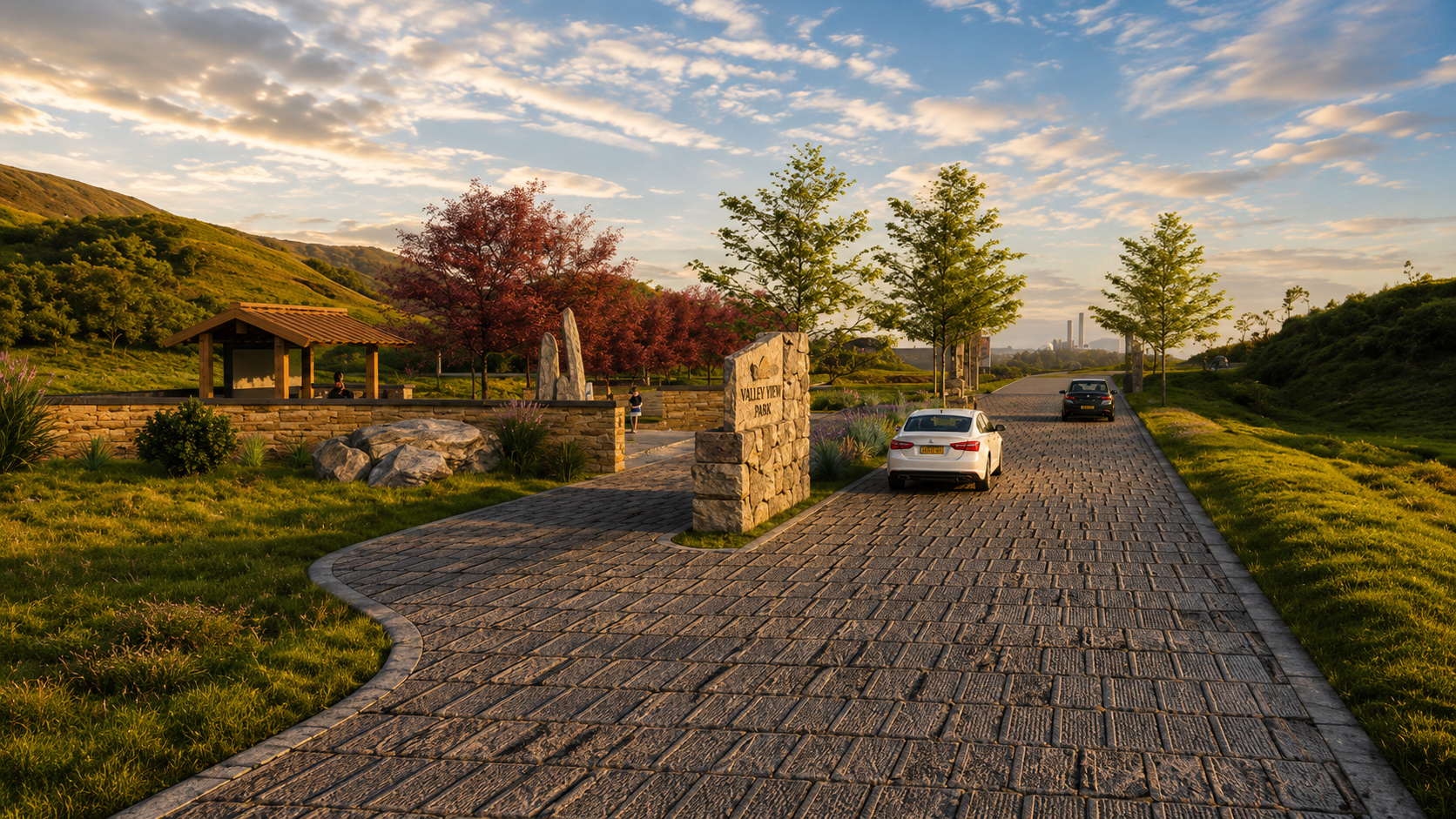
Its strategic location between Cherrapunjee and Nongriat helps regional connectivity, redistributes tourist movement, and extends economic and cultural benefits to surrounding communities, while safeguarding a fragile ecological landscape.
Architecture as an Extension of the
Landscape
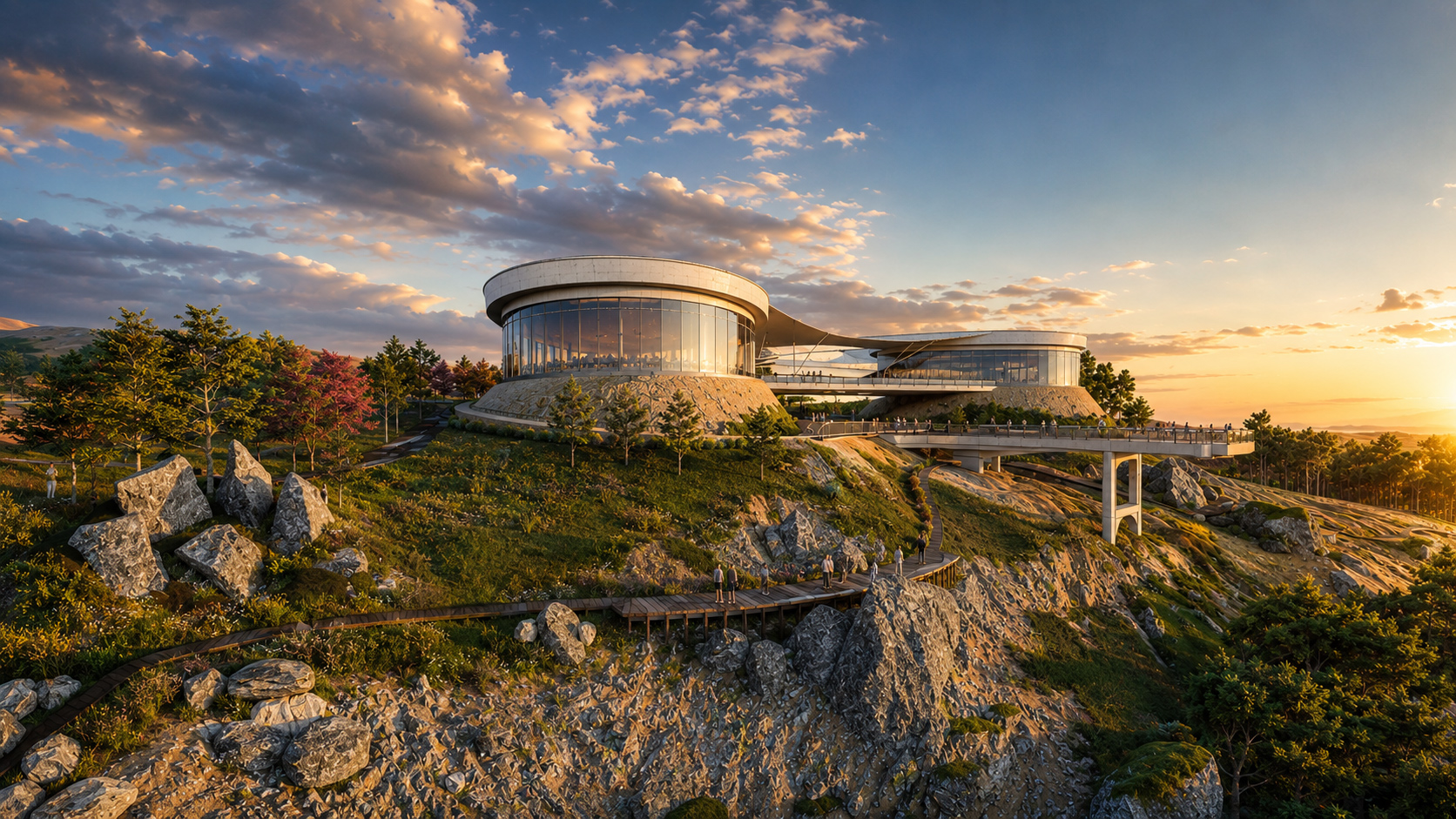
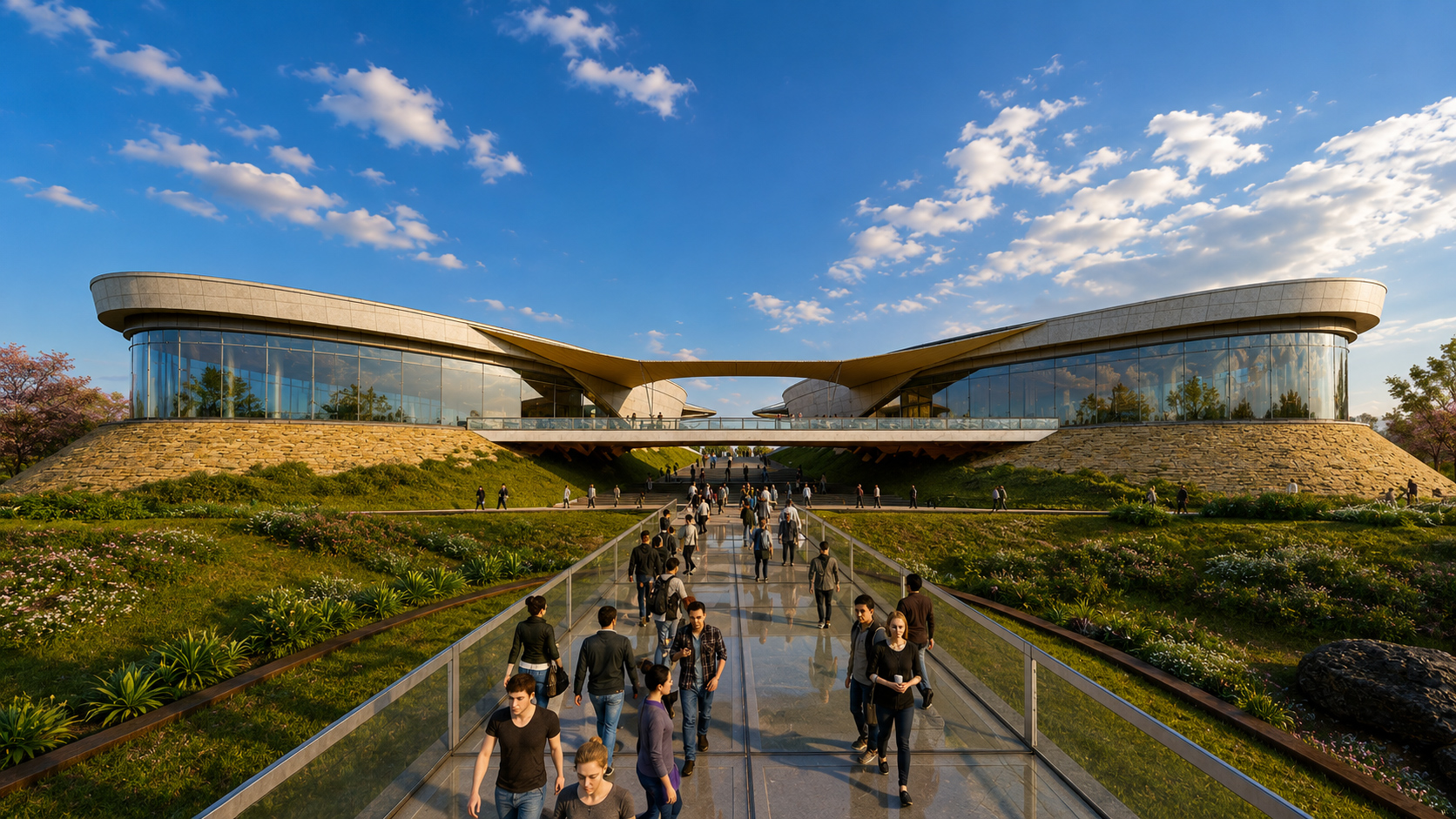
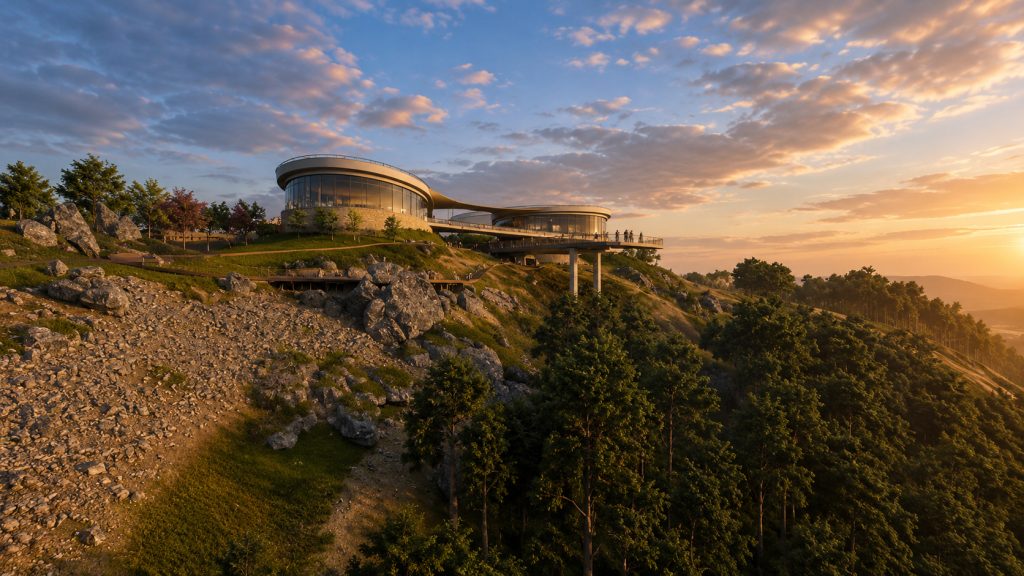
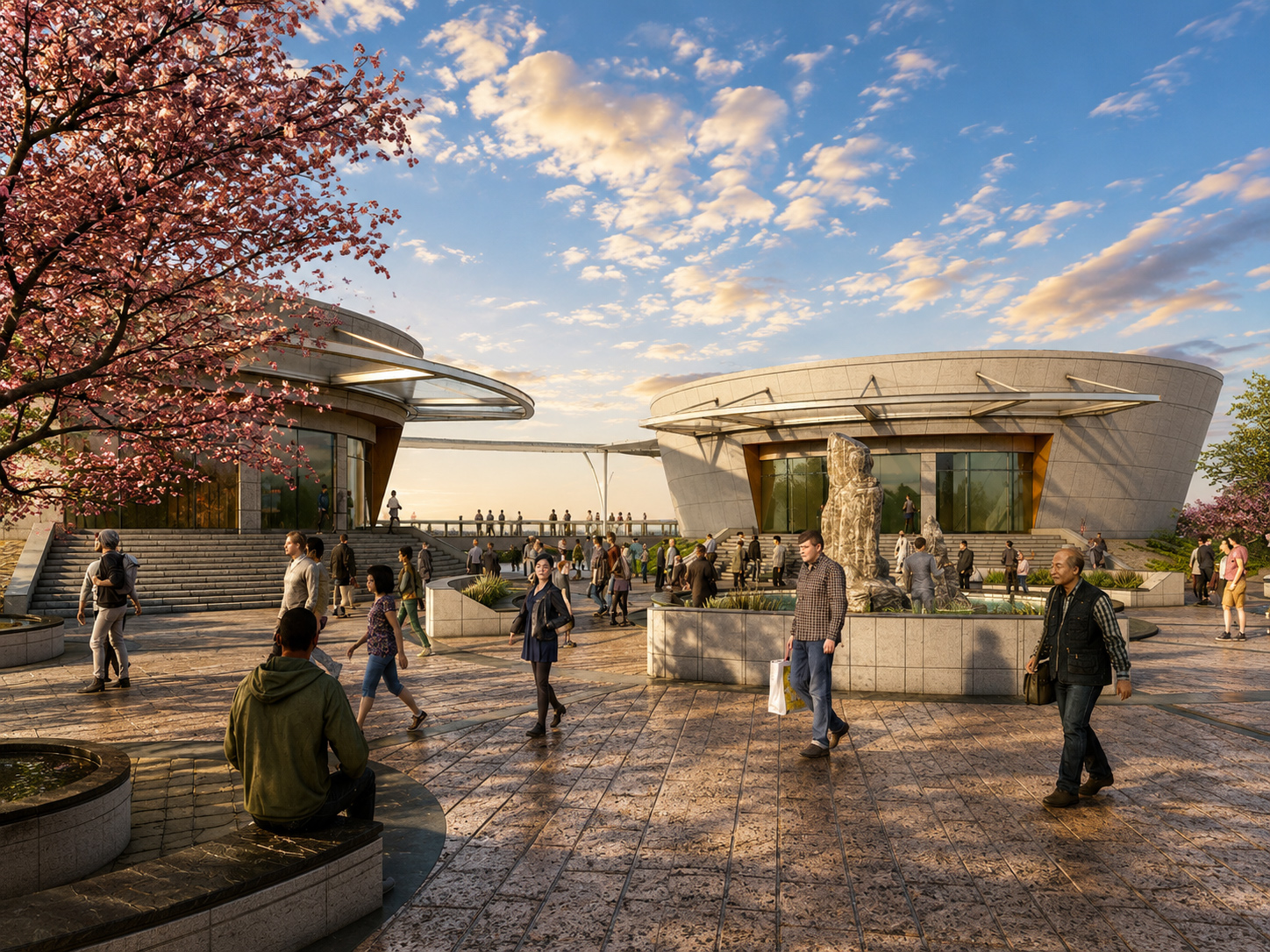
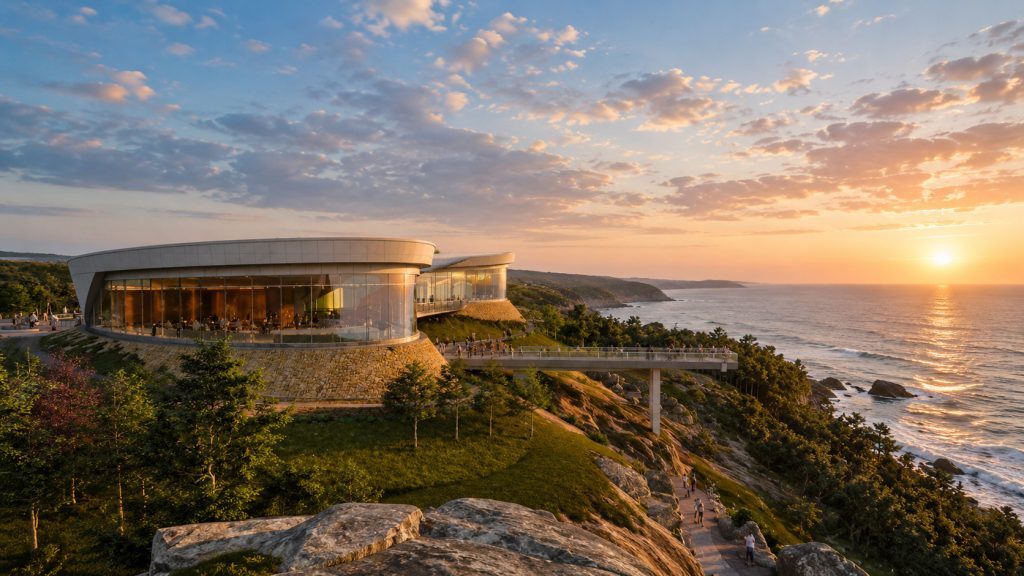
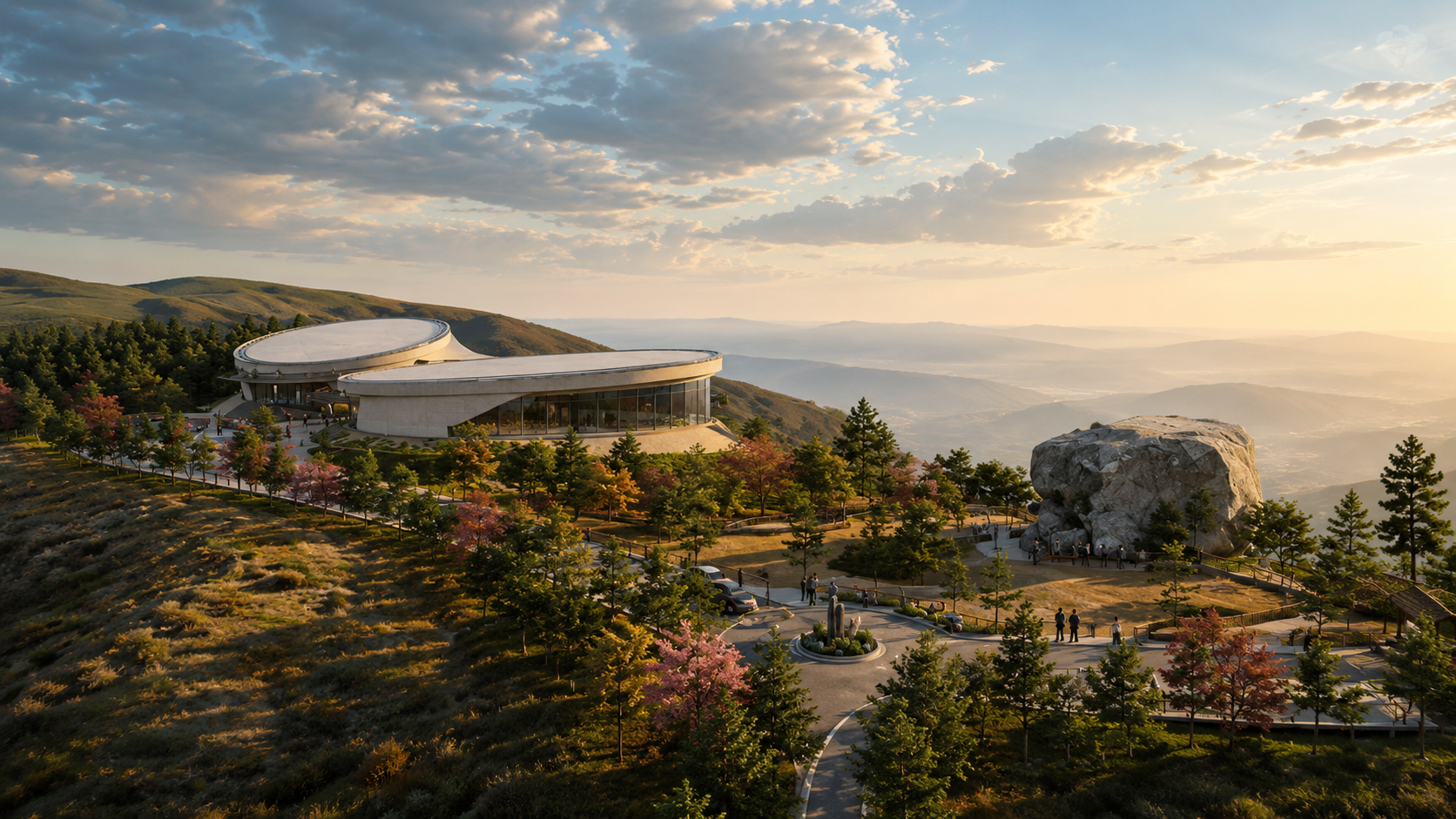
The architectural approach is guided by restraint, humility, and continuity with the terrain. Straddling a cliff edge, the Experience Centre is conceived as a pair of gently contoured, elliptical building forms, positioned on either side of a natural depression and embedded into the landscape. The two curved volumes operate as complementary anchors within a larger spatial system, deliberately creating a central open court that frames views of the valley and establishes a powerful relationship with the terrain.
A bridge spans between the two volumes, functioning both as a connective spine and a viewing platform. This elevated link choreographs movement across the site, allowing visitors to pause, orient themselves, and engage with the landscape before continuing their journey. The open space formed between the buildings is not residual, but intentionally shaped as an orienting court, mediating scale, light, and topography while reinforcing the experience of arrival and transition.
The building functions as both a museum and a learning environment, accommodating galleries, learning spaces, and visitor amenities without rigid hierarchies. Exhibitions, immersive media, and tactile installations narrate the intertwined stories of rainfall, rock formation, climate change, and human settlement.
Materiality, scale, and form respond directly to the region’s heavy rainfall, dense vegetation, and karst geology. Rooflines follow land profiles, built volumes are fragmented to reduce visual impact, and open, shaded spaces facilitate natural ventilation and controlled daylight. Architecture here is not symbolic but performative, shaping experience while remaining environmentally responsive, acting as a quiet interpreter rather than a competing presence.
A Choreographed Journey Through
Time
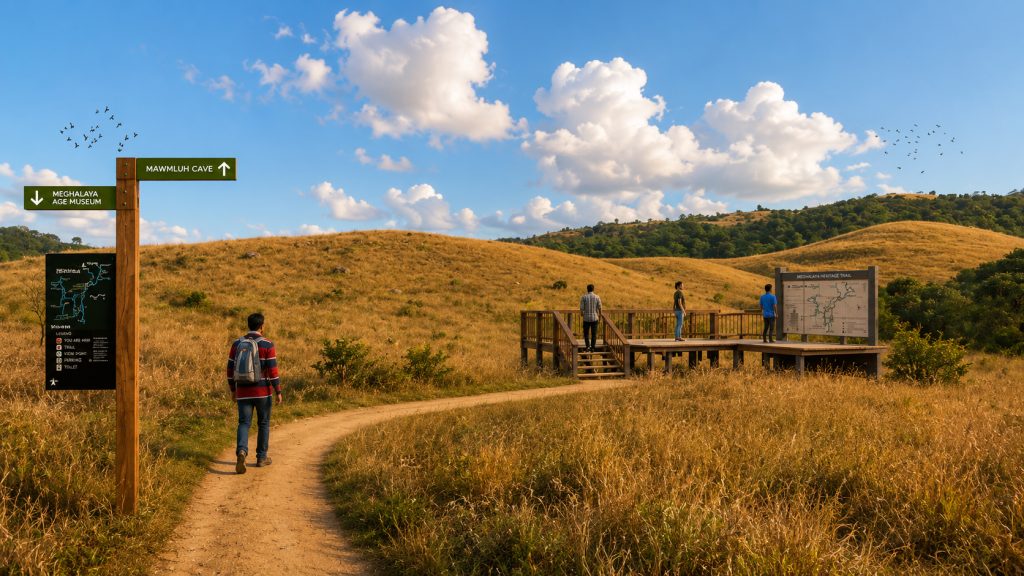
The project is conceived as a sequenced spatial journey, transitioning visitors from familiar landscapes into geological deep time. Pathways, trails, and viewing platforms act as interpretive devices, revealing shifts in terrain, sound, light, and microclimate.
The Experience Centre anchors this journey, functioning as an orienting threshold that translates geological processes into legible narratives and prepares visitors for the cave experience. From here, movement continues as a gradual descent toward the cave, where architectural intervention recedes and the natural environment takes precedence, allowing visitors to intuitively experience the scale and temporality of deep geological time.
Architecture as an Interpretive
Framework that balances Access, Conservation, and Community
The project demonstrates how design can operate across scales, from territorial planning to detailed spatial sequences, to reveal invisible histories embedded within the land. In doing so, it positions architecture as a mediator between science, culture, and environment, enabling long-term conservation while fostering public understanding and regional identity.
 Surat, Gujarat, India